How far does $120 go when sent to a Virginia prison inmate?
$120 goes in. $44.44 reaches him.
Someone's family puts $120 on a debit card for a man in a Virginia prison. Before he can spend a cent on anything he chose, $75.56 of it is gone. Not stolen, and not hidden — every deduction below is published, and each one has a reason attached. They just run one after another on the same money.
I drew this for the Center for Public Integrity in 2014, to run with Daniel Wagner's reporting on prison banking. The reporting holds up. My execution of it didn't, so I redrew it.
Who these three are
- JPay
- A private vendor. It is paid for moving the money, and then paid again for what the money is spent on.
- The state
- The Virginia Department of Corrections. It deducts from the deposit, and takes a commission on what JPay sells.
- What is left
- The remainder, spendable at the prison store.
How to read it

The commission is the part worth sitting with
Of the $51.90 JPay takes, $2.80 goes back to the Department of Corrections — a cut of the email stamps and the album downloads. The state earns more when JPay charges more. That was not the original intent.
What I got wrong the first time
The 2014 version is below. It was built from the same figures and it reaches the same total, so nothing here is a correction of fact. What it got wrong was the reading.
The bands were S-curves that crossed each other in the lower half, so you could not follow one from left to right without losing it. Every amount sat in a row underneath, so you read a number and then went hunting for the band it belonged to. There were three colours doing three unrelated jobs, and the green one read as good when all it meant was not taken yet. And the commissary list — the eight items that are the entire point, because they add up to exactly what is left — was a column parked beside the picture instead of the end of it.
What it could not tell you, then or now
The two commission flows were labelled $1.00 and $1.80, and the band receiving them was labelled $2.90. The itemised figures are the right ones and the total was a typo. It is $2.80 here.
The original also looks as though its arithmetic does not close, and that is worth saying plainly because it was mine. Virginia takes 15% of the balance after JPay's fee — 10% to mandatory savings, 5% to fees and fines. On $111.05 that is $11.105 and $5.5525. The 2014 graphic printed those rounded, then used the rounded figures for some of the running balances across the top and the exact ones for the totals at the end. Two arithmetics in one picture, about a cent apart. Here everything is carried in full and rounded once, at the moment it is printed.
One thing neither version can tell you: whether $120 is a typical deposit. It was the figure the reporting used. The percentages hold at any amount; the dollars do not.
The original
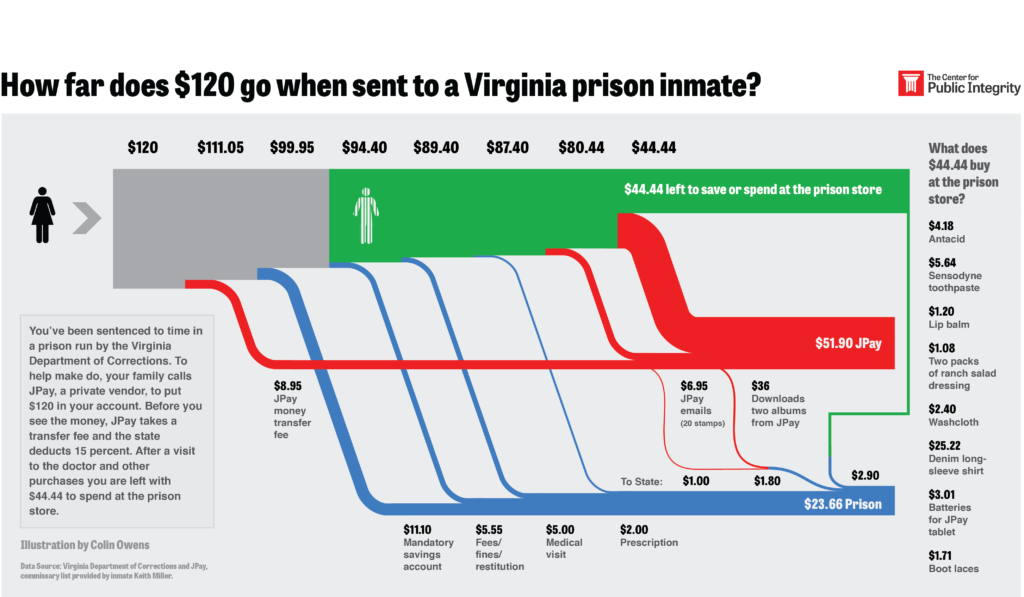
Illustration by Colin Owens, for Prison bankers cash in on captive customers by Daniel Wagner. The Center for Public Integrity, 30 September 2014.
Virginia Department of Corrections and JPay; commissary list provided by inmate Keith Miller
Sources
- Prison bankers cash in on captive customers
- Daniel Wagner for the Center for Public Integrity, 30 September 2014. The reporting the graphic was drawn for.
- How far does $120 go when sent to a Virginia prison inmate?
- The original illustration. Sourced to the Virginia Department of Corrections and JPay, with a commissary list provided by inmate Keith Miller.